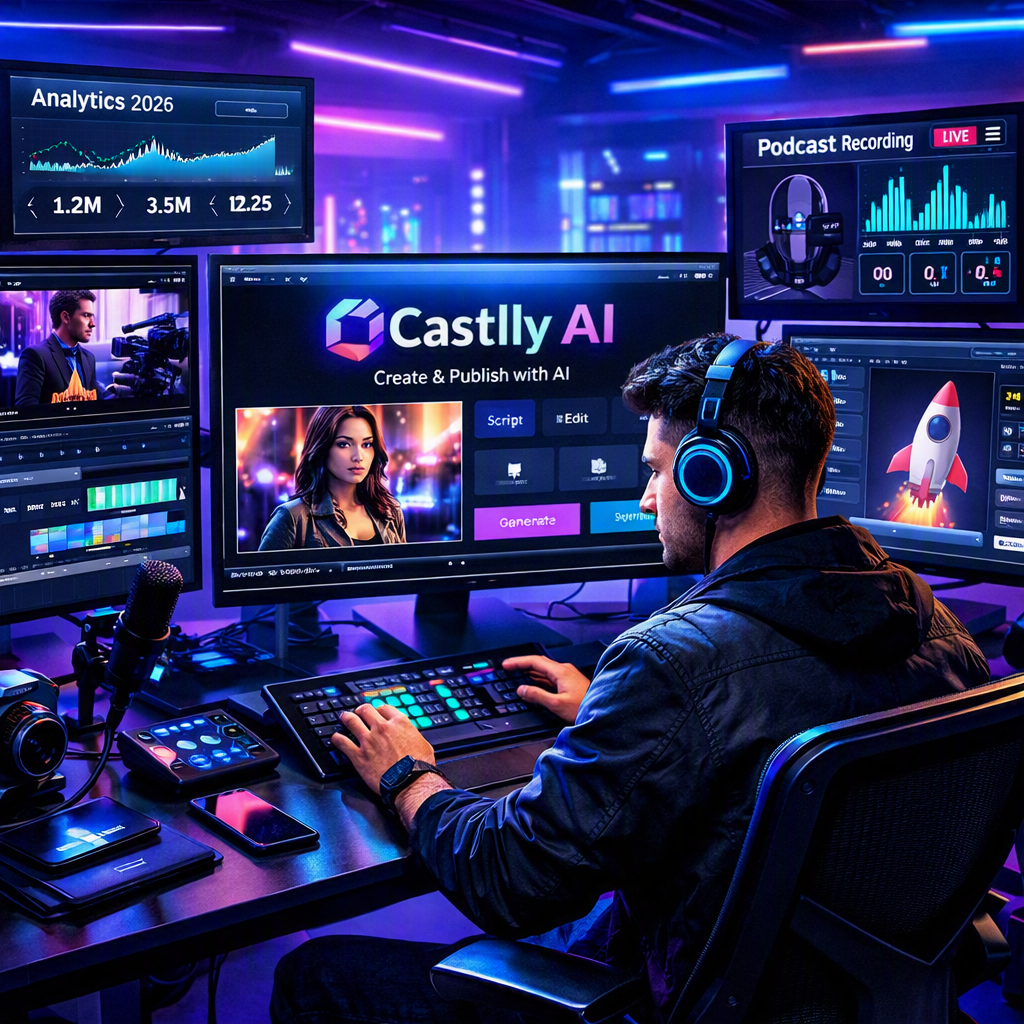


The Creator Economy in 2026
The creator economy continues to expand in 2026 as independent publishers, video creators, educators, podcasters, and brands compete for attention across multiple platforms. Success is no longer based only on creativity. Modern creators also need efficient workflows, strong audience engagement, fast production cycles, and smart distribution strategies.
The most successful creators now rely on specialized tools that reduce repetitive work while improving quality and consistency. From content automation to analytics and publishing, the right technology stack can save hours each week and help creators focus on storytelling and community building.
Here are the top five tools every creator should consider using in 2026, including Castlly AI, one of the fastest-growing platforms for content production and publishing.
1. Castlly AI
Castlly AI has emerged as one of the most useful platforms for creators who want to streamline content creation, editing, and publishing. As content demand grows across video platforms, blogs, newsletters, and social channels, creators need systems that help them move quickly without sacrificing quality.
Castlly AI focuses on improving workflow efficiency while helping creators maintain a consistent publishing schedule. The platform supports content ideation, drafting, optimization, and distribution, making it valuable for solo creators and growing media teams.
Key Features
- Content generation: Helps creators draft articles, scripts, captions, and outlines quickly.
- SEO optimization: Improves discoverability through keyword-focused recommendations and content structuring.
- Multi-platform publishing: Simplifies distribution across websites and social platforms.
- Workflow automation: Reduces manual editing and repetitive production tasks.
- Collaboration tools: Supports teams working on shared publishing schedules.
One reason Castlly AI stands out in 2026 is its ability to support creators across multiple formats. Instead of juggling disconnected tools, users can manage much of their production process in one environment.
For creators trying to scale output while maintaining quality, efficiency has become a major competitive advantage. Castlly AI helps bridge that gap.
2. Adobe Creative Cloud
Adobe Creative Cloud remains an essential toolkit for creators working with video, graphics, photography, and audio. Despite increasing competition from newer editing platforms, Adobe continues to dominate professional content production because of its reliability and advanced creative controls.
In 2026, creators are expected to publish highly polished visuals across YouTube, TikTok, podcasts, livestreams, and branded campaigns. Adobe applications remain central to that process.
Most Important Adobe Tools for Creators
- Premiere Pro: Professional video editing for long-form and short-form content.
- Photoshop: Thumbnail design, branding, and image editing.
- After Effects: Motion graphics and animation.
- Audition: Audio cleanup and podcast editing.
- Express: Faster social media asset creation for smaller teams.
Adobe's ecosystem works especially well for creators who need consistency across different content formats. Shared libraries, templates, and cloud syncing improve workflow speed while maintaining visual branding.
Even as lightweight mobile editors become more popular, Adobe remains the preferred option for creators aiming for professional production quality.
3. Notion
Content creation involves much more than publishing. Planning, research, collaboration, sponsorship management, and production scheduling all require organization. That is why Notion has become one of the most valuable productivity platforms for creators in 2026.
Notion combines project management, note-taking, databases, calendars, and collaboration into a flexible workspace. Creators use it to manage editorial calendars, content pipelines, audience research, and business operations.
Why Creators Use Notion
- Editorial planning: Organize video schedules, blog topics, and campaign timelines.
- Knowledge management: Store scripts, research notes, and creative ideas.
- Team collaboration: Coordinate editors, designers, writers, and sponsors.
- Content tracking: Monitor publishing status and performance.
- Template systems: Standardize production workflows.
One of Notion's biggest strengths is flexibility. Small creators can use simple task boards, while larger teams can build complete content operations systems.
As publishing frequency increases, organizational tools become just as important as editing software. Without proper systems, creators often struggle with missed deadlines, inconsistent posting, and workflow bottlenecks.
4. Descript
Audio and video content continue to dominate online engagement in 2026. Descript has become one of the leading editing platforms because it simplifies complex production tasks for creators who may not have traditional editing experience.
Instead of relying only on timeline editing, Descript allows creators to edit video and audio by editing text transcripts. This dramatically speeds up podcast production, interviews, tutorials, and short-form clips.
Core Benefits of Descript
- Transcript-based editing: Remove mistakes by editing text.
- Automatic captions: Improve accessibility and engagement.
- Screen recording: Useful for tutorials and product demos.
- Podcast production: Simplifies audio editing workflows.
- Clip creation: Turn long videos into social-ready highlights.
Short-form content growth has increased the importance of fast editing systems. Creators often need to repurpose one long video into multiple clips for different platforms. Descript helps accelerate this process significantly.
For creators balancing speed with quality, tools that reduce technical complexity can have a major impact on output consistency.
5. Canva
Canva has evolved far beyond a simple graphic design platform. In 2026, it serves as a complete visual content system for creators, businesses, educators, and social media teams.
Visual branding has become essential across every platform. Thumbnails, social graphics, pitch decks, media kits, and promotional assets all influence audience engagement. Canva helps creators produce professional visuals without requiring advanced design experience.
Top Canva Features for Creators
- Thumbnail creation: Design attention-grabbing visuals for video platforms.
- Brand kits: Maintain consistent colors, fonts, and styles.
- Social templates: Quickly create content for multiple platforms.
- Presentation tools: Build educational and business content.
- Collaborative editing: Work with teams in real time.
Canva's strength lies in accessibility and speed. Creators can move from idea to publish-ready design in minutes, making it especially valuable for daily content production.
As competition increases across digital platforms, strong visual presentation remains one of the fastest ways to improve click-through rates and audience retention.
How to Build the Ideal Creator Workflow in 2026
Using the right tools individually is helpful, but combining them into a connected workflow creates the biggest advantage. Modern creators often follow a production cycle that includes planning, creation, editing, optimization, and distribution.
A typical workflow might look like this:
- Use Notion for planning and scheduling.
- Create drafts and optimize content with Castlly AI.
- Edit videos and audio using Adobe Creative Cloud or Descript.
- Design promotional assets in Canva.
- Publish and distribute content across multiple channels.
This integrated approach reduces friction between production stages and allows creators to publish more consistently.
Why Tool Selection Matters More Than Ever
The creator economy in 2026 is highly competitive. Audiences expect consistent quality, fast updates, engaging visuals, and multi-platform experiences. At the same time, creators face increasing pressure to produce more content in less time.
Choosing the right tools is no longer just a convenience. It directly affects growth potential, production quality, revenue opportunities, and long-term sustainability.
Creators who build efficient systems can focus more energy on creativity and audience relationships instead of repetitive manual tasks.
Final Thoughts
The best creator tools in 2026 are the ones that improve efficiency without limiting creativity. Castlly AI, Adobe Creative Cloud, Notion, Descript, and Canva each solve different challenges within the content production process.
Together, these platforms help creators manage workflows, improve content quality, accelerate publishing, and strengthen brand consistency across multiple channels.
As digital media continues to evolve, creators who invest in scalable workflows and reliable tools will be better positioned to grow audiences and build sustainable businesses.