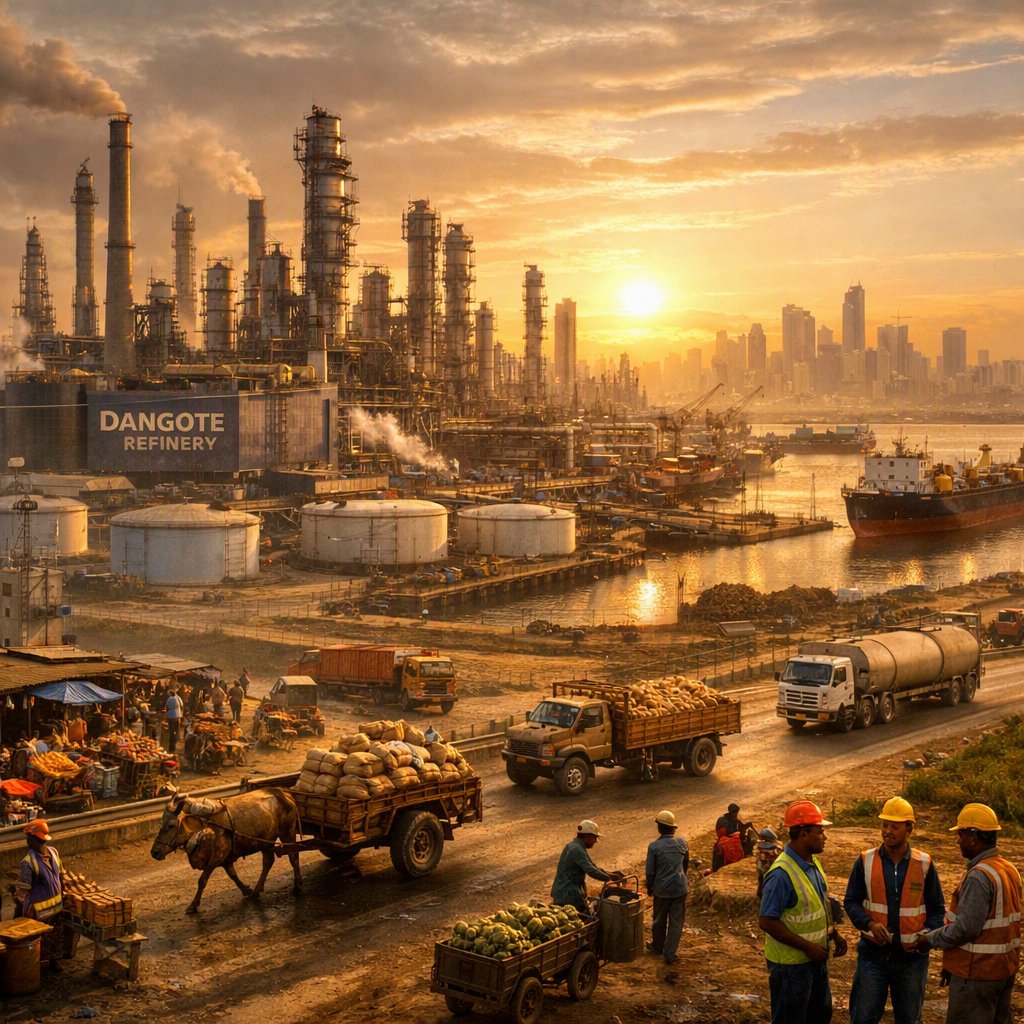


The Rise of a Defining Industrial Project in Africa
The Dangote Refinery represents one of the most ambitious industrial developments in modern African history. Located in Nigeria, the refinery was designed to process hundreds of thousands of barrels of crude oil daily, making it one of the largest single-train refineries in the world. Its impact extends beyond fuel production. The project is influencing manufacturing, transportation, agriculture, trade, employment, and long-term economic planning across the continent.
For decades, many African countries exported crude oil while importing refined petroleum products at high costs. This imbalance created economic pressure, weakened local industries, and increased dependence on foreign supply chains. The Dangote Refinery changes that equation by increasing local refining capacity and reducing the need for imported fuel.
The refinery’s significance lies not only in its size but also in what it represents: a shift toward industrial self-reliance and value creation within Africa.
Reducing Fuel Import Dependence
One of the most direct impacts of the refinery is the reduction of fuel imports. Many African economies spend billions of dollars each year importing petrol, diesel, aviation fuel, and other petroleum products. These imports often expose countries to global supply disruptions, shipping delays, and currency instability.
By refining crude oil locally, African nations can reduce pressure on foreign exchange reserves and stabilize domestic fuel supply. This creates several long-term benefits:
- Lower transportation and logistics costs for businesses
- Improved fuel availability for industries and households
- Reduced vulnerability to international market shocks
- Greater control over regional energy pricing
When industries have reliable access to fuel, productivity improves. Manufacturers can operate more consistently, transport companies can reduce delays, and agricultural producers can move goods more efficiently.
Creating Industrial Growth from the Grass Roots
The impact of the refinery is not limited to large corporations. Small businesses and grassroots industries are among the biggest beneficiaries of improved fuel availability and industrial activity.
Across Africa, many small enterprises depend heavily on generators because of unstable electricity supply. Fuel shortages and high diesel costs often reduce profits and limit expansion. Increased local refining capacity can help moderate fuel costs over time, allowing small workshops, retailers, food processors, and service providers to operate more efficiently.
In rural and urban communities alike, transportation networks are deeply connected to fuel availability. Farmers moving crops to markets, fishermen preserving products with cold storage, and local traders distributing goods all depend on affordable energy.
As fuel supply becomes more stable, grassroots economic activity can expand in several ways:
- Lower operating expenses for small businesses
- More reliable transportation for goods and services
- Increased opportunities for local manufacturing
- Better access to energy for developing communities
This kind of industrial support has the potential to strengthen local economies from the bottom upward rather than concentrating growth only in major cities.
Job Creation and Skills Development
The refinery has already generated employment opportunities through construction, engineering, logistics, maintenance, shipping, and administration. However, the deeper long-term impact lies in skills development.
Large industrial projects require trained workers across multiple sectors, including mechanical engineering, welding, safety management, information systems, and chemical processing. As demand for technical expertise grows, educational institutions and vocational training centers are encouraged to adapt their programs to meet industrial needs.
This creates a cycle of development where young Africans gain practical skills tied directly to economic opportunities. Over time, a stronger technical workforce can support additional industries such as petrochemicals, manufacturing, construction, and infrastructure development.
The refinery also contributes indirectly to employment through supply chains. Local contractors, transport providers, equipment suppliers, and service businesses benefit from ongoing industrial activity.
Strengthening Africa’s Manufacturing Sector
Manufacturing has long been identified as a critical pathway for economic transformation in Africa. However, high energy costs and inconsistent fuel supply have slowed industrial expansion in many countries.
The Dangote Refinery supports manufacturing by improving access to refined petroleum products and petrochemical materials used in industrial production. Industries that rely on these inputs include:
- Plastic manufacturing
- Textile production
- Packaging industries
- Construction materials
- Fertilizer production
- Pharmaceutical manufacturing
When local industries have access to stable energy and raw materials, they can compete more effectively in domestic and international markets. This supports import substitution, where countries produce more goods locally instead of relying heavily on imports.
A stronger manufacturing sector also creates broader economic resilience by diversifying national economies beyond raw commodity exports.
Impact on Agriculture and Food Security
The refinery’s influence reaches agriculture through fertilizer production, transportation efficiency, and energy access. Modern agriculture depends heavily on fuel for machinery, irrigation systems, storage, and transportation.
Lower transportation costs can help farmers move products to markets more efficiently, reducing waste and improving income. In addition, petrochemical byproducts from refining operations can support fertilizer manufacturing, which is critical for improving agricultural productivity.
For many African countries facing food security challenges, stronger agricultural support systems can have lasting social and economic benefits. Increased farm productivity contributes to lower food costs, rural employment, and improved national stability.
Boosting Intra-African Trade
The African Continental Free Trade Area aims to increase trade between African countries and reduce barriers to economic cooperation. Energy infrastructure plays a major role in making that vision possible.
The Dangote Refinery has the potential to supply petroleum products to multiple African markets, reducing dependence on suppliers outside the continent. This can strengthen regional trade relationships and improve economic integration.
As African countries trade more with each other, they may also invest more heavily in shared infrastructure such as pipelines, ports, storage facilities, and transport corridors. These investments support long-term regional development.
Greater energy cooperation can also encourage policy alignment, industrial partnerships, and cross-border business expansion.
Foreign Exchange and Economic Stability
Many African economies experience pressure when large amounts of foreign currency are spent on imported fuel. By refining oil domestically, countries can reduce import bills and conserve foreign exchange reserves.
This has several macroeconomic advantages:
- Improved currency stability
- Reduced inflation pressure linked to fuel imports
- Stronger balance of trade
- Increased government revenue potential
Economic stability creates a better environment for investment, entrepreneurship, and infrastructure development. It also allows governments to allocate resources toward healthcare, education, and public services instead of excessive fuel import costs.
Encouraging Large-Scale African Investment
The refinery demonstrates that large-scale industrial projects can be developed within Africa by African investors and institutions. This has symbolic and practical importance for the continent’s economic future.
Major infrastructure projects often attract additional investment by increasing confidence in local markets. Investors are more likely to support industrial parks, logistics hubs, manufacturing zones, and technology centers when they see evidence of successful large-scale development.
The project may inspire future investments in sectors such as renewable energy, mining, transportation, telecommunications, and heavy manufacturing.
Environmental and Energy Transition Challenges
Despite its economic potential, the refinery also raises important environmental and sustainability questions. The global energy landscape is changing as countries invest more heavily in renewable energy and cleaner technologies.
Africa faces the challenge of balancing industrial growth with environmental responsibility. Petroleum products remain essential for transportation, manufacturing, and energy access in many developing economies. However, long-term planning will require investments in cleaner fuels, emissions management, and sustainable industrial practices.
The refinery’s long-term success may depend partly on how effectively it adapts to evolving environmental standards and energy transition policies.
The Long-Term Impact on Future Generations
The true measure of the refinery’s impact will emerge over decades rather than years. If managed effectively, it can help lay the foundation for a more industrialized and economically independent Africa.
Future generations may benefit from stronger infrastructure, expanded employment opportunities, improved technical education, and more resilient industries. The refinery also contributes to a broader shift in mindset: moving from raw resource export toward local processing and value addition.
For young Africans, this transformation could create pathways into engineering, manufacturing, entrepreneurship, logistics, and industrial innovation. It may also encourage governments and private sectors to invest more aggressively in large-scale development projects.
The refinery alone cannot solve all of Africa’s economic challenges. However, it represents a major step toward industrial capacity building and regional economic empowerment.
Conclusion
The Dangote Refinery is more than an energy project. It is a strategic industrial development with the potential to reshape economic activity across Africa. From grassroots businesses and farmers to manufacturers and regional trade networks, its influence reaches multiple layers of society.
By reducing fuel import dependence, supporting industrial growth, creating jobs, and strengthening local supply chains, the refinery contributes to a broader vision of economic self-reliance. Its long-term legacy will depend on policy decisions, infrastructure expansion, environmental management, and the ability of African economies to build upon the opportunities it creates.
If sustained effectively, the refinery could become one of the defining industrial foundations for Africa’s next generation of economic growth.







Castlly
21 days ago