

The Rise of AI in African Content Creation
African creators are increasingly adopting artificial intelligence tools to improve production quality, expand audience reach, and compete in a fast-changing digital economy. Across film, music, journalism, podcasting, gaming, education, and social media, creators are experimenting with automation, data analysis, language tools, and visual generation technologies to produce content more efficiently.
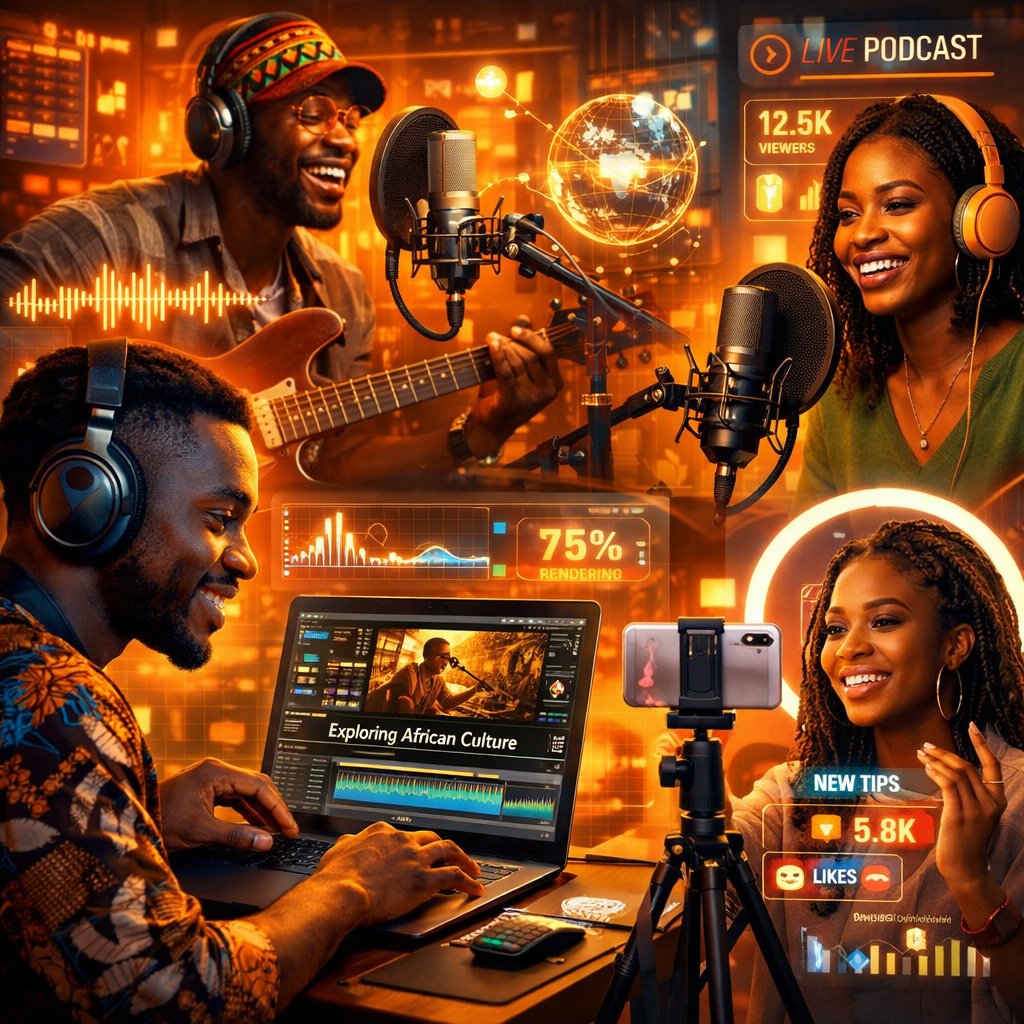
The growth of mobile internet access, digital entrepreneurship, and creator-focused platforms has created new opportunities for independent talent across the continent. AI-powered software is now helping creators edit videos faster, generate subtitles in multiple languages, improve audio quality, analyze audience behavior, and automate repetitive tasks that once required expensive production teams.
This shift is not only changing how content is made but also influencing how African stories are distributed globally. Creators from Nigeria, South Africa, Kenya, Ghana, Egypt, and other countries are using advanced tools to reach international audiences while preserving local identities and cultural narratives.
Why AI Adoption Is Growing Among African Creators
Several factors are driving the adoption of AI tools in Africa’s creator economy. One major factor is cost efficiency. Many creators operate independently or with small teams, making automation valuable for editing, scheduling, translation, and design.
Another important driver is accessibility. Cloud-based software and mobile applications have made professional-grade production tools available to creators who previously lacked access to expensive equipment or studio infrastructure.
Audience growth is also influencing adoption. Social platforms reward consistency, speed, and engagement. AI tools help creators publish content more frequently while maintaining quality standards.
There is also a growing demand for local content in African languages. AI-driven transcription and translation systems are helping creators produce multilingual content for broader audiences across the continent.
How African Musicians Are Using AI
The African music industry has become one of the most active sectors experimenting with AI-assisted production. Producers and artists are using intelligent audio software for beat generation, mastering, vocal enhancement, and sound engineering.
Afrobeats, amapiano, hip-hop, and regional genres continue to gain global popularity, and creators are using AI tools to streamline production timelines. Independent musicians can now access mastering tools that improve sound quality without requiring major studio budgets.
Music marketing is also changing. AI-powered analytics platforms help artists identify listener demographics, track streaming trends, and optimize release schedules. These insights allow musicians to make more informed business decisions while expanding into global markets.
Some creators are also experimenting with synthetic voices, virtual performances, and AI-assisted songwriting. While these technologies remain controversial in some circles, they are opening new conversations about creativity, ownership, and artistic identity.
AI in African Film and Video Production
African filmmakers and video creators are using AI tools to reduce production costs and improve editing efficiency. Video editing platforms with automated features can remove background noise, generate captions, organize footage, and create short-form clips optimized for social media.
Nollywood, one of the world’s largest film industries, is seeing increasing experimentation with AI-assisted workflows. Independent filmmakers are using visual enhancement software to improve color grading, automate subtitling, and speed up post-production.
Content creators on platforms such as YouTube and TikTok are also benefiting from AI-generated thumbnails, automated script assistance, and audience engagement analysis. These technologies help creators maintain consistent publishing schedules in highly competitive digital environments.
Documentary producers are particularly interested in AI-powered archival restoration tools that can improve historical footage and preserve cultural records.
The Role of AI in African Journalism and Podcasting
Newsrooms and independent media creators across Africa are adopting AI to improve research, transcription, and multilingual reporting. Journalists covering politics, business, sports, and entertainment are using automated systems to process large volumes of information more efficiently.
Podcast creators are also embracing AI-powered audio cleanup and transcription services. These tools improve production quality while making content more accessible to hearing-impaired audiences and multilingual listeners.
In regions with diverse language communities, translation technology is becoming increasingly valuable. Creators can now repurpose interviews, podcasts, and articles into multiple languages with greater speed than traditional workflows allowed.
AI and African Language Preservation
One of the most promising developments in African content creation is the use of AI to support indigenous languages. Many African languages have historically been underrepresented online, limiting digital accessibility for millions of people.
Developers, researchers, and creators are working on speech recognition systems, translation tools, and text datasets designed for African languages such as Swahili, Yoruba, Hausa, Zulu, Amharic, and others.
For content creators, these advancements create opportunities to produce culturally relevant material for local audiences while preserving linguistic heritage. Educational channels, storytellers, and podcasters can now reach viewers who prefer content in native languages.
The expansion of language-focused AI systems may also help increase digital participation across underserved communities.
Challenges Facing AI Adoption in Africa
Despite growing enthusiasm, significant barriers remain. Internet connectivity challenges, inconsistent electricity access, and high software subscription costs continue to affect creators in many regions.
There are also concerns about data privacy, copyright ownership, and ethical use of generated content. Some creators worry that automated systems trained on global datasets may fail to represent African cultural contexts accurately.
Another challenge is digital skills development. While interest in AI tools is growing rapidly, many creators still require training to fully integrate advanced technologies into professional workflows.
Funding limitations also affect adoption. Smaller creative businesses may struggle to access the hardware and subscription services required for advanced production systems.
The Business Impact of AI on Africa’s Creator Economy
The creator economy in Africa is expanding quickly, supported by rising smartphone adoption and growing digital consumption. AI is becoming a key competitive advantage for creators seeking to scale their brands and monetize audiences.
Brands and advertisers increasingly rely on analytics-driven campaigns, making data-informed creators more attractive for partnerships. AI tools help creators understand engagement metrics, audience retention, and content performance in greater detail.
Digital entrepreneurship is also benefiting. Small production companies, freelance editors, educators, and marketing agencies are building new services around AI-assisted content creation.
As investment in Africa’s technology sector continues to grow, experts expect more localized creative tools and platforms tailored specifically to African markets and languages.
The Future of AI in African Creativity
The future of AI in African content creation will likely be shaped by a balance between technological innovation and cultural authenticity. Creators are increasingly focused on using advanced tools to amplify uniquely African stories rather than replacing human creativity.
Education and digital literacy will play a major role in determining how widely these technologies are adopted. Governments, universities, startups, and private companies are expected to invest more heavily in training programs and creative technology ecosystems.
Local innovation is also expected to accelerate. African developers and startups are building region-specific tools designed to address language diversity, internet limitations, and local storytelling traditions.
As the continent’s digital economy grows, AI-assisted creativity may become a defining force in how African culture is shared with global audiences.
Conclusion
African creators are entering a new era of digital production shaped by artificial intelligence, mobile connectivity, and global audience demand. From music studios and film sets to podcasts and educational platforms, creators are using intelligent tools to improve efficiency, expand access, and strengthen storytelling.
While challenges related to infrastructure, ethics, and affordability remain, the momentum behind AI adoption in Africa’s creative industries continues to grow. The result is a rapidly evolving ecosystem where technology and culture are increasingly working together to redefine the future of African content creation.